The Family of Carl von Baudissin
The wife of Carl Heiberg was Asta, Countess von Baudissin (11), the daughter of Count (“Count”

corresponds to “Graf” in German.) Carl Christian von Baudissin (22). In her memoirs Asta relates

that, the night before a formal party, she had dreamed that Carl Heiberg would kiss her on her
shoulder, which would be bare as was the custom at that time (1835). At the party the next day,
Heiberg did what she expected. Thus they were engaged; they soon got married.
Asta and Carl complemented each other very well. While Carl was shy and modest - my
grandmother told me that she once observed her father sewing a button on his coat - Asta was
resolute and determined, rational and logical. Whenever any of their relatives got into trouble - and
that happened frequently - they asked Carl and Asta for help. More will be said about Asta later in
this chapter.
The Baudissin family had lived in Schleswig-Holstein for decades and owned a number of large
estates. Originally, however, the Baudissins had come from the city of Bautzen in the eastern part
of what is now called Saxony, north of the northern tip of Bohemia. "Baudissin" was the original
name of the city of Bautzen. This name is the second one of the two purely Slavonic names among
those of my ancestors. (The first one was Subklev on Ruegen).
One of the early Baudissins, Wulff Heinrich (704), 1579-1646, served during the Thirty Years War

under the ruler of Saxony as well as under the King of Denmark, eventually as a field Marshal. He
married Sophia von Rantzau, (She was 16 years old, he was 57- MNF) who came from a leading
family of noblemen in Holstein. The descendents of this couple lived partly in Saxony, partly in
Holstein.
One of these descendents, Heinrich Christian, Count von Baudissin (88), was married to Susanne
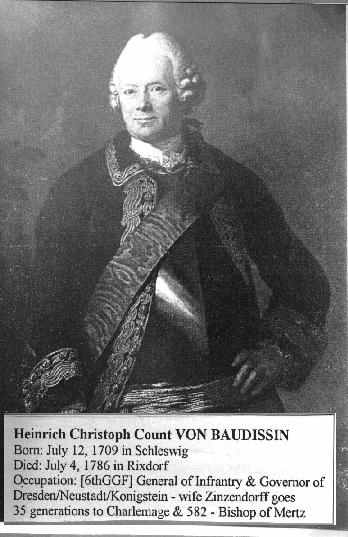
Magdalene Countess von Zinzendorff (89). Her grandfather, Georg Ludwig Count von
Zinzendorff*,
*A sister of Georg Ludwig is an ancestor of Queen Victoria, who thus was a 5th cousin of Asta
Baudissin.
a half-brother of the founder of a famous pietist sect, was married to Maria Elisabeth Baroness von
Teuffel (357).
The Zinzendorffs were originally Protestant refugees from Austria. Their ancestry can be traced far
back, in fact to Charlemagne and beyond. A short such ancestry line will be shown in Appendix 4
A son of Heinrich Christian Baudissin, Heinrich Friedrich (44), the father of Carl Christian, was at

some time the ambassador of the King of Denmark at the court of the King of Prussia. The story is
told that while traveling from Copenhagen to Berlin, which took several days, he always sat upright
and never leaned back in his coach. This is all the family tradition has to tell about him with one
exception.
Chart of Asta Baudissin Ancestors

In earlier times it was customary among well-off people to spend the evenings by playing at cards -
for money. On one occasion Heinrich Friedrich’s wife owed her opponent an enormous sum at
the end of a game. The opponent offered to forget the debt if she allowed him to give her a kiss.
She refused, so her husband had to sell one of his estates to pay for her gambling debt.
Heinrich Friedrich's wife was Caroline Adelhaid von Schimmelmann (45). Much will be said about
her father later on. Her mother Caroline Tugendreich* (*Tugendreich means “Rich in Virtue.â
€�) was the daughter of a Prussian officer, Alexander von Friedeborn and his wife Marie von
Maellenheim (183). Caroline grew up as if she were adopted by a nobelman, Heinrich von
Gersdorff, who had his estate in Saxony near the place in Prussia at which von Friedeborn was
stationed. It was generally assumed that Caroline Tugendreich was actually the daughter of Heinrich
von Gersdorff. In later years, when she lived in Hamburg and Denmark, she was always named
"nee von Gersdorff", even in legal documents. Her husband had seen to that.
Caroline Tugendreich's husband, Heinrich Carl Schimmelmann (90), was born in 1724 in a small

city in Pomerania, north of Berlin, as the youngest son of a prosperous merchant. His mother's
father, Johann Ludendorff, also a prosperous merchant, was the ancestor of two famous people,
the astronomer Ludendorff and the General Ludendorff.
In later years it was frequently assumed that Heinrich Carl Schimmelmann was a Jew, because of
very primitive "reasons": his name, his prominent nose, and his spectacular success as a merchant*
*He was sometimes called the Rothschild of the North.
Such primitive assumptions appeared frequently in print and were accepted to some degree, even in
the family.
When Heinrich Carl Schimmelmann was about 18 years old he made himself independent. After
some years he started a business in Dresden, the capital of the state of Saxony, and soon, when he
was 23 years old, he married Caroline Tugendreich, the foster-daughter of Heinrich von Gersdorff,
who was then minister of commerce of the state of Saxony. In 1756, after the start of the Seven
Years War, in which Saxony and Prussia were on opposite sides. Schimmelmann left Saxony and
soon he worked for King Frederick II of Prussia by selling to England (via Hamburg) the stock of
the famous China (Porcellane) factory in the city of Meissen (which then belonged to Saxony). In
doing this he made a great fortune. After that he settled in Hamburg as a merchant. Later on, he
became Treasurer of Denmark and he was also made a Count. He was the richest man in Denmark
at that time. He died in 1782. The great fortune he left fizzled out more or less in three or four
generations.
I should like to mention that Schimmelmann owned sugar plantat-ions on the Virgin Islands, which
then belonged to Denmark. His oldest son, who was mainly interested in poetry and literature,
nevertheless succeeded his father as Treasurer of Denmark. He made a great effort to eliminate
slavery on the Virgin Islands. After some years he succeeded in having the importation of slaves
into these islands forbidden. Thus Denmark became the first country to do that. (England was the
next country to do that. Somewhat later England forbade slavery altogether and Denmark followed
soon after.)
I now turn to the descendents of Heinrich Friedrich von Baudissin(44)and his wife, the daughter of
Schimmelmann. They had three sons and several daughters. Only two of their sons, Carl and
Joseph, had descendents who live today.
A grandson of Joseph acquired a law degree and became a high government official in Prussia: his
son Wolf von Baudissin was an army officer in the Second World War. After the war, as a general,
he was in charge of the democratization of the new West German Army. He joined the social
Democratic party and is highly respected by the labor unions. Later on he was in charge of strategy
for NATO in Paris and Brussels. Now he is a professor of strategy at the University of Hamburg.
We are good friends with him and his wife; we always visit them when we have a chance to pass
through Hamburg on our travels in Europe.
The life of the second son of Heinrich Friedrich(44) and Caroline Adelheid (45), Carl Christian

(22), was rather peculiar and the same can be said, more or less, about some of his descendents.
Chart of Heinrich Baudissin Decendents

When Carl was 19 years old, he eloped with Henriette Kunniger (23), the wife of a Danish officer.
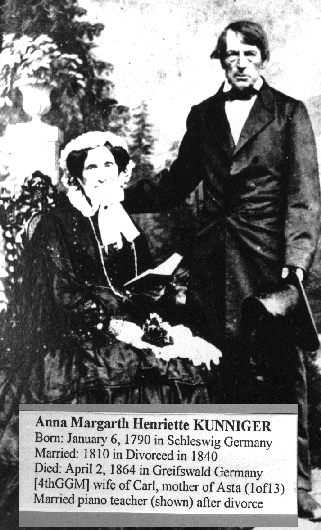
She was the daughter of a very respectable government official in Schleswig, Kammerrat Kunniger
(46). His father (92), in turn, was an actor and theater director in the city of Flensburg in the
northern part of Schleswig.
The elopement caused quite a shock to the family. Carl was disinherited by his parents and he was
also denied recognition as a Count. Some years later though, he was again accepted as a Count.
After being divorced from her husband, Henriette got married to Carl Baudissin. The couple moved
restlessly from one place to another, and produced many children; thirteen in fact. At first they
stayed near Dresden, where they had the chance to observe the Napoleonic armies pass by. Carl, so
his daughter said, always carried a loaded gun, so he could shoot Napoleon if he had a chance. The
next place at which they stayed for a while was the city of Greifswald, (near Rügen). There one
daughter was born. In Greifswald Carl had heard about the Count of Putbus on Rügen and his habit
of giving his daughters strange names such as Wanda and Asta. Carl himself had the same
inclination; so he named their daughter “Asta.” This daughter was my great-grandmother (11).
Eventually Carl and Henriette lived on a small estate in the central part of Jütland, the mainland of
Denmark, north of Schleswig. Later on they lived in the city of Schleswig.
The characters of Carl (22) and Henriette (23) are described in a striking way by their daughter

Asta in the Memoirs, which she wrote, (of which I have a copy) (Martin now has the copy - MNF)
. A pertinent excerpt from this book is appended, A3. Her own strong and determined character
becomes clear in the excerpt. But her description of the characters of her parents, though certainly
correct, is not easily reconciled with the following story which is based on family tradition and some
letters.
On some occasion, when both Carl and Henriette were about 50 years old, Carl entered a room in
which Henriette was playing the piano and saw that her music teacher, Peters, had placed his arm
on Henriette’s shoulder. Carl turned, left the room without saying a word and sued for divorce
(1840). After the divorce Henriette had to marry Peters, who then took a small position in the city
of Stralsund. Henriette lived with Peters for 24 years till her death. I have the impression that her
children were mainly on their father’s side, but at least Asta’s husband Carl Heiberg corresponded
with Henriette, his mother-in-law, and with Peters.
I should like to make a few remarks about the 13 children, six sons and seven daughters, of Carl
and Henriette Baudissin. The oldest son, Wolf, was a postmaster; his son Friedrich was an admiral
in charge of Kaiser Wilhelm’s Yacht. Four of the other six sons of Carl emigrated to America since
their chances were small under the Danish regime. One of them intended to become a physician by
studying with a practicing doctor; but he died soon. Another son returned to Schleswig Holstein.
The youngest of the four, Felix, became a farmer, but lost the farm due to the depression in the
1870’s.
Our son David found out that grandchildren of Felix existed and were living in St. Louis. One
grandson wrote to us that it is 111 years that someone of his family had heard from their family in
Germany. He was a press operator. One granddaughter owns a beauty shop; another is an audit
assistant. For some years we have corresponded with her.
The fourth of the four sons who went to America, Adelbert, served in the northern army in the
Civil War and then returned to Germany. He became a prolific writer; among others he wrote
books for German immigrants to America. We are good friends with two of his granddaughters in
Munich.
One of the seven daughters of Carl and Henriette was not married; another one did not marry a
nobleman; but the five other daughters did. The names of the husband of one of them was Marquis
de Cubieres; the names of the other husbands are: von Bischofshausen, von Stockhausen, von
Lilienkron, von Luckner, von Arnim.
A daughter of Charlotte von Arnim was married to a Lutheran minister in a small town in Silesia.
One of their daughters, Elisabeth, was married to a sports journalist, Karl Markus. We knew the
Markus family quite well since they lived for some years in Düsseldorf, where we also lived at that
time. In particular we have maintained contact with their youngest son, Karl-Lutz Markus.
Go to Chapter 8 Go to main History page
| THE FRIEDRICHS FAMILY WEB SITE Contact: Marty.Friedrichs@Gmail.com |
 |  |  |  |  |  |  |  |